


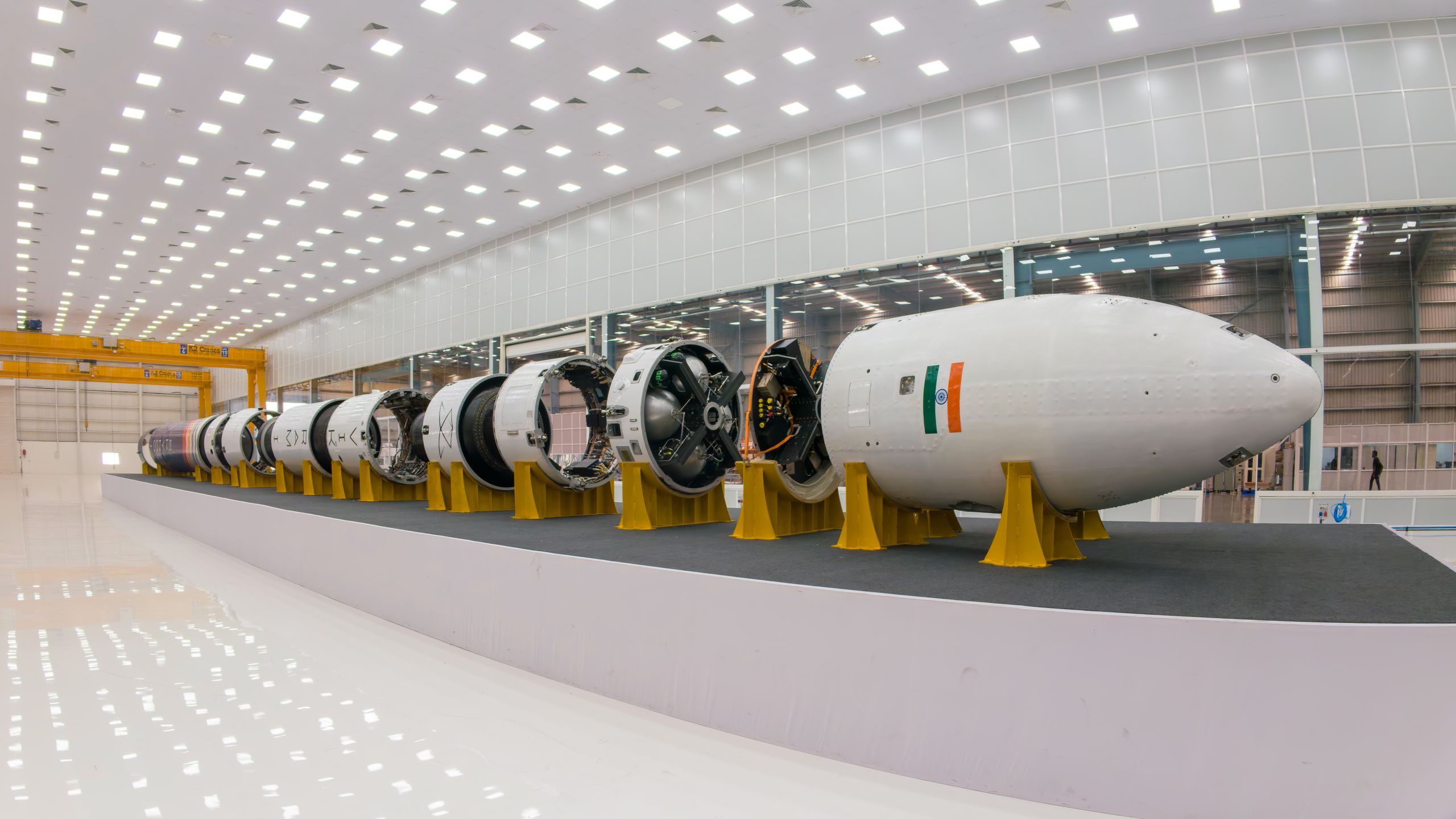
Getting Vikram-1 to Orbit: Inside Skyroot Aerospace’s Historic Mission
HYDERABAD, India — Skyroot Aerospace is on the verge of making history with its first orbital rocket, Vikram-1, which is set to launch between July 12 and August 4, 2026. The fully assembled rocket now stands on the launch pad at the Satish Dhawan Space Centre in Sriharikota, overseen by a launch team of approximately 200 personnel, representing about one-fifth of the company’s workforce.
Vikram-1 is designed to place multiple customer payloads into low Earth orbit at an altitude of 280 miles (450 kilometers). If successful, this mission, named Aagaman — which means « arrival » in Sanskrit — will mark the first time a private Indian company has launched a satellite to orbit.
The rocket features an Orbit Adjustment Module, a liquid-fueled upper stage that can restart its engine, distinguishing it from the three solid-fueled lower stages. This capability allows Vikram-1 to deploy multiple satellites into different orbits during a single mission. The mission manifest includes several payloads: Skyroot’s SCOPE satellite, a technology demonstration from Germany’s DCUBED, Grahaa Space’s SOLARAS S3 satellite, and a robotic arm from Cosmoserve Space designed to capture orbital debris.
Two symbolic payloads will also be included: a floral artwork named Cosmic Bloom from Cosmos Diamonds and a miniature gold rocket by artist Ajay Kumar Mattewada, honoring Indian scientific pioneers.
Skyroot’s co-founder and CEO, Pawan Kumar Chandana, emphasized the company’s strategy to provide dedicated launches for small satellites, allowing customers to tailor missions to their specific orbital requirements. This approach contrasts with existing models where satellites are launched as secondary payloads aboard larger rockets.
Aagaman is the first of three planned development flights to validate Vikram-1 before commercial operations commence. If the vehicle performs as expected, Skyroot aims to scale production to one orbital rocket per month from its two Hyderabad campuses.
Skyroot first garnered attention in 2022 when its Vikram-S vehicle became the first privately developed Indian rocket to reach space. Developing Vikram-1 took an additional four years, with the rocket needing to achieve an altitude of 280 miles (450 km) and accelerate payloads to approximately 8 km (5 miles) per second to remain in orbit.
The Indian space sector has evolved significantly since Skyroot was founded in 2018, transitioning from a state-dominated industry to a burgeoning ecosystem of over 400 startups. Recent government policies have opened the space sector to private companies, allowing them to design, test, and launch their technologies.
As India’s space economy continues to grow, projected to reach about $40 billion in the next decade, Skyroot is already looking beyond small satellites, planning to develop larger launch vehicles and invest in reusable rocket technology to reduce costs.
The final days leading up to the launch are critical for the Skyroot team, who express a palpable sense of excitement as they prepare for the debut of India’s first privately developed orbital rocket.
Source: Space.com